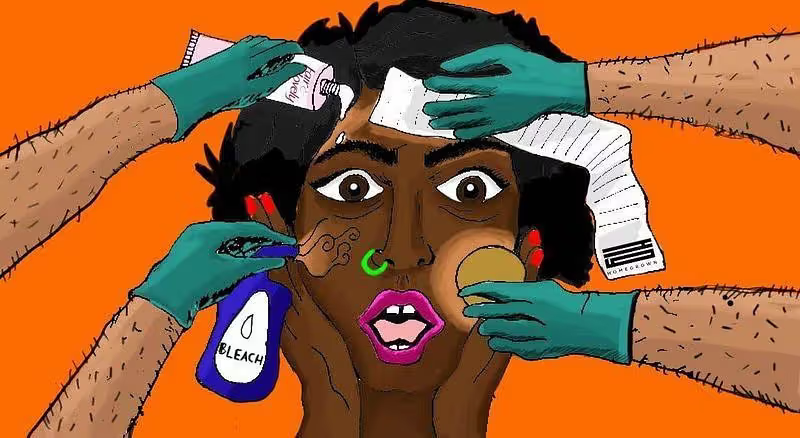
Credit: Homegrown webpage
Picture this: you are in a room full of chuckling folks, each delivering a witty one-liner after another. Laughter fills the air, and you are all having a grand time, unless you happen to be the punchline. Welcome to the world of jokes about dark skin in India, where the humour comes at the expense of people who happen to be a shade darker.
Sometime back, a friend attempted to convey to me a perplexing viewpoint: they believed it was abhorrent when white people made remarks about Indians and our brown skin, yet strangely acceptable, even funny, when we, as Indians, cracked similar jokes about dark-skinned fellow Indians, mostly women. This paradox exposed a deeply ingrained mentality that it is acceptable to belittle our own people.
Beauty standards upheld by the media serve as a driving force behind these biases. Advertisements inundate us with the message that lighter skin is more desirable, causing dark-skinned women to feel invisible and unrepresented. The impact is profound, with consequences that extend beyond mere jokes.
Jokes targeting dark skin are not simply offensive because they imply a personal flaw. They highlight a systemic problem in our society where dark skin is unfairly devalued. This unfair treatment is palpable when we are bombarded with advertisements promoting fairness creams and rarely see dark-skinned women in lead roles on television.
Growing up, I experienced first-hand the weight of these biases. I remember a friend casually referring to me with a cruel nickname intended as a joke. But in the midst of the mirth, the line between a roast and bullying seemed elusive. Those words carried a hurtful declaration that I was an outlier, not quite fitting the mould of societal expectations for attractiveness.
As time distances me from those earlier interactions, I recognize that the foundation of deep friendships and relationships does not hinge upon my ability to endure being the punchline. It does not require me to cast myself as the comic relief to secure a place within the circle. Rather, it is the authentic connections, devoid of mockery, that have come to mean the most.
It is crucial to acknowledge that colourism is not just a minor issue that can be overshadowed by seemingly more pressing concerns. Comparing various injustices does not diminish the significance of any of them. Rather, it is a reminder that we need to be allies for one another, recognizing that societal biases take various forms and contribute to a larger problem of discrimination.